Common Mistakes Referral Agents Make (And How to Avoid Them)
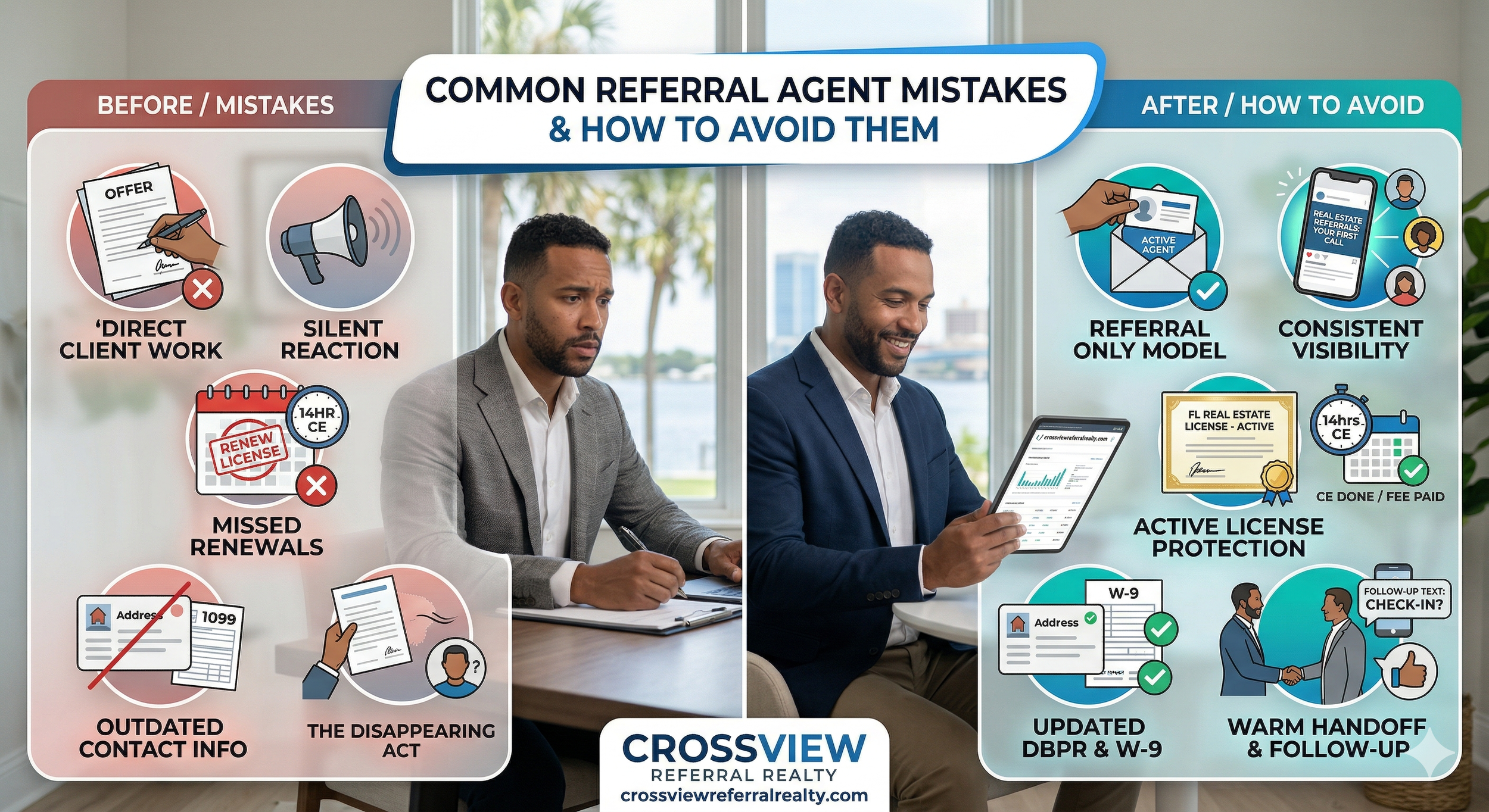
What are the most common mistakes referral agents make — and how do you avoid them?
The referral model is genuinely simple, but simple doesn't mean there's nothing to get wrong. Whether you're brand new to a referral brokerage or you've been at it for a while, these are the mistakes we see most often — and the ones that quietly cost agents money, relationships, and sometimes their license.
Mistake #1: Working With Clients Directly
This is the one that can get you into real trouble, so it comes first.
When your license is held with a referral-only brokerage like CrossView Referral Realty, you are not permitted to represent buyers or sellers in a transaction. That means no showings, no writing offers, no listing appointments, no negotiating on anyone's behalf. Your role is to make the connection — refer the client to a licensed active agent, and earn a referral fee when the deal closes.
It can feel natural to help, especially with people you've worked with for years. But crossing that line puts you, your client, and your brokerage at risk. If someone in your network needs to buy or sell, the right move is always to refer them — not to step in and handle it yourself.
Mistake #2: Not Telling Anyone You're a Referral Agent
Your network is your entire business as a referral agent. If people don't know what you do, they can't send you anything.
This is one of the most common and most avoidable mistakes. Agents make the transition to a referral brokerage and then go quiet — they don't tell past clients, they stop posting, they assume people will figure it out. They won't.
Every past client should hear directly from you that you've moved to a referral model. Beyond that, stay visible. Post occasionally on social media. Let people know that when real estate comes up — buying, selling, relocating anywhere in the country — you're still their first call. You'll connect them with the right agent and stay involved in making sure they're taken care of. You don't need to post every day, but you do need to stay on people's radar. A referral agent who nobody thinks to contact isn't really a referral agent — they're just someone with a license parked somewhere.
Mistake #3: Missing DBPR Renewals and Continuing Education
Florida real estate licenses renew every two years, and every single renewal period, someone at CrossView Referral Realty lets their deadline slip by. It happens more often than you'd think — life gets busy, the reminder email gets buried, and suddenly a license that was perfectly active is now involuntarily inactive.
Keeping your Florida license active requires two things: completing 14 hours of FREC-approved continuing education and paying your DBPR renewal fee before your expiration date. Neither is particularly difficult or expensive. But if you miss the window, your license status changes — and depending on how long it's been inactive, getting it back can require significantly more CE hours or, worst case, starting from scratch entirely.
Put your renewal date in your calendar now. Set a reminder three months out. The CE courses can be completed entirely online at your own pace. Don't let something this preventable be the reason you lose a license you worked hard to earn.
Mistake #4: Not Updating Your Address — With Everyone Who Needs It
This one catches people off guard. If you move, you're required to update your mailing address with DBPR. That's a Florida licensing requirement, not optional. But it doesn't stop there.
You also need to update your address with your broker. And while you're at it, make sure your W-9 on file reflects your current information — because that's what gets used to issue your 1099 at the end of the year. If your tax documents go to an old address, that's a headache you don't need. Same goes for any direct deposit or payment information you have on file. A change of address is a five-minute task that protects you from a surprisingly long list of problems.
Mistake #5: Disappearing After the Referral Handoff
Submitting the referral and walking away entirely is a mistake. You don't need to manage the transaction — that's not your role — but staying loosely in touch with your client shows them you care about how things go, not just about the fee.
A quick check-in text after the handoff goes a long way. Something simple like, "Hey — just checking in to make sure you connected with [agent name] and things are off to a good start." That's it. It keeps the relationship warm, and it means your client is more likely to think of you again — and send others your way — long after the deal closes.
At CrossView Referral Realty, we follow up with the receiving agent monthly and keep you updated on your referral's progress. But that personal touch from you to your client? Only you can provide that.
If you have questions about how the referral model works at CrossView or want to make sure you're set up to avoid these pitfalls, we're happy to talk it through. Visit crossviewreferralrealty.com or call us at 904-503-0672.
FAQ
Q: What happens if I accidentally work with a client directly as a referral agent? A: Working directly with buyers or sellers when your license is held at a referral-only brokerage is a violation of your agreement and Florida real estate regulations. It can put your license at risk and create legal exposure for you and your brokerage. If someone reaches out expecting you to represent them, the right move is always to redirect — let them know you'll connect them with the best agent for their situation and submit a referral.
Q: How do I make sure I don't miss my Florida real estate license renewal? A: Set a calendar reminder at least three months before your license expiration date. Your license expires on either March 31 or September 30 every two years, depending on when you were originally licensed. DBPR will send a notice to the email address they have on file — which is another reason to keep your contact information updated with them.
Q: Do I have to update DBPR every time I move? A: Yes. Florida law requires licensees to keep their current mailing address on file with DBPR. Beyond the legal requirement, it's also practical — renewal notices and important communications go to whatever address DBPR has on record. Update your broker at the same time, and review your W-9 to make sure your tax documents will reach you.
Q: How often should I stay in touch with past clients as a referral agent? A: There's no magic number, but the goal is to stay present without being pushy. A check-in a few times a year — a birthday message, a quick note when something relevant happens in the market, or a simple "thinking of you" text — is enough to keep you top of mind. The key is consistency over time, not frequency in any given month.
Q: Can I make promises to my client about what the receiving agent will deliver? A: No — and this is worth being careful about. As a referral agent, your role is to make the connection, not to manage the transaction or guarantee its outcome. Avoid promising specific timelines, prices, or results. What you can genuinely promise is that you'll work to connect them with the right agent and that you'll stay in their corner throughout the process.