Do Real Estate Referral Agents Need E&O Insurance?
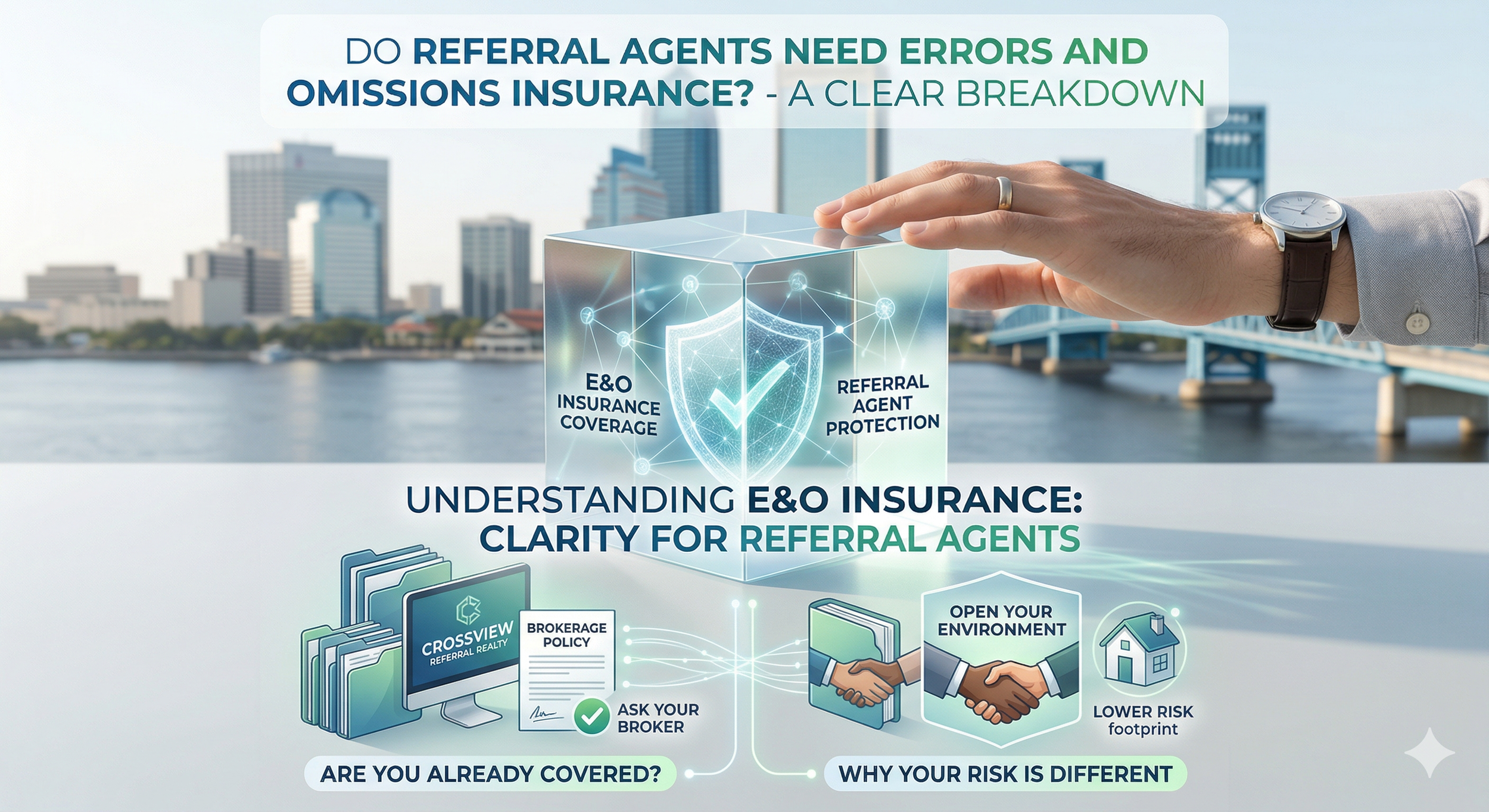
Do referral agents need errors and omissions insurance — and are you already covered through your brokerage?
These are fair questions, and the answers matter. Here's a clear breakdown of how E&O insurance applies to referral agents in Florida, why your risk profile is different from an active agent's, and what you should do to make sure you're protected.
What E&O Insurance Actually Covers
Errors and omissions insurance — commonly called E&O — is professional liability coverage that protects real estate licensees against claims of negligence, mistakes, or oversights in the performance of their professional duties. Think missed disclosures, contract errors, misrepresentation of a property's condition, or a paperwork mistake that cost a client money.
For active agents handling listings, buyer representation, contracts, and negotiations, E&O is essentially non-negotiable. The exposure is real and significant — even a minor error in a transaction can trigger a claim that costs tens of thousands of dollars in legal fees alone, regardless of whether the claim has merit.
Does Florida Require E&O for Referral Agents?
Florida does not legally require real estate agents — active or referral — to carry E&O insurance as a condition of licensure. It is not a DBPR requirement.
That said, many brokerages carry their own E&O policy that covers the brokerage and its agents. Whether that coverage extends to referral agents, and under what circumstances, depends entirely on the brokerage you're with. This is one of the most important questions to ask before you place your license anywhere.
Why Your Risk Is Lower as a Referral Agent
Here's the practical reality: as a referral agent, your exposure is dramatically different from an active agent's.
You're not writing contracts. You're not handling disclosures. You're not advising clients on pricing, negotiating on their behalf, or managing a transaction. Your role is to make the connection — refer the client to a licensed active agent and step back. The active agent and their brokerage carry the liability for everything that happens in the transaction itself.
That doesn't mean zero risk. If a client claimed your referral recommendation was negligent — that you connected them with an agent who was unqualified or a poor fit in a way that caused them harm — there's a theoretical exposure there. But it's a much narrower footprint than what active agents carry.
What You Should Do
The most important step is simple: ask your broker directly what E&O coverage is in place and whether it extends to referral agents at your brokerage. Get a clear answer before you assume you're covered — or before you assume you're not.
If you're with CrossView Referral Realty and have questions about how coverage works, reach out to us directly. We're happy to walk through what's in place and help you understand your situation clearly. Every agent's circumstances are a little different, and we'd rather you have accurate information than make assumptions in either direction.
If you determine you want your own individual E&O policy on top of whatever brokerage coverage exists, individual policies for referral agents are available and generally more affordable than policies for active agents, given the reduced liability exposure. It's worth getting a quote if peace of mind matters to you.
The bottom line: E&O isn't legally required in Florida for referral agents, your risk exposure is meaningfully lower than an active agent's, but you should always know exactly what coverage you have before you need it.
Have questions about how CrossView Referral Realty is structured or what protections are in place for our agents? Call us at 904-503-0672 or visit crossviewreferralrealty.com.
FAQ
Q: Is E&O insurance required to keep a Florida real estate license active? A: No. Florida's DBPR does not require errors and omissions insurance as a condition of keeping your real estate license active. It is not part of the renewal or CE process.
Q: Am I covered under my brokerage's E&O policy as a referral agent? A: It depends entirely on the brokerage and how their policy is structured. Some brokerage E&O policies extend to all agents under their license; others may have limitations. The right move is to ask your broker directly and get a clear answer rather than assuming either way.
Q: Why is a referral agent's liability exposure lower than an active agent's? A: Because referral agents don't handle the transaction. You're not writing contracts, advising on price, managing disclosures, or negotiating on a client's behalf. The active agent and their brokerage carry the liability for the transaction itself. Your role — making the referral connection — is a much narrower scope of professional activity.
Q: Can I get my own individual E&O policy as a referral agent? A: Yes. Individual E&O policies are available to referral agents in Florida. Because your scope of activity is more limited than an active agent's, premiums are typically lower. If having your own portable coverage gives you peace of mind, it's worth getting a quote from a provider that specializes in real estate professional liability.
Q: What's the difference between brokerage E&O and individual E&O? A: Brokerage E&O covers the brokerage and its agents for claims arising from their activities under that brokerage. Individual E&O travels with you — it covers you regardless of which brokerage you're with. If you change brokerages, individual coverage doesn't lapse. For most referral agents, brokerage coverage is sufficient, but agents who want continuous portable protection sometimes choose to carry both.