Florida Real Estate License Renewal: What the Continuing Education Requirement Actually Takes
Wondering what it actually takes to keep your Florida real estate license active if you're not selling anymore?
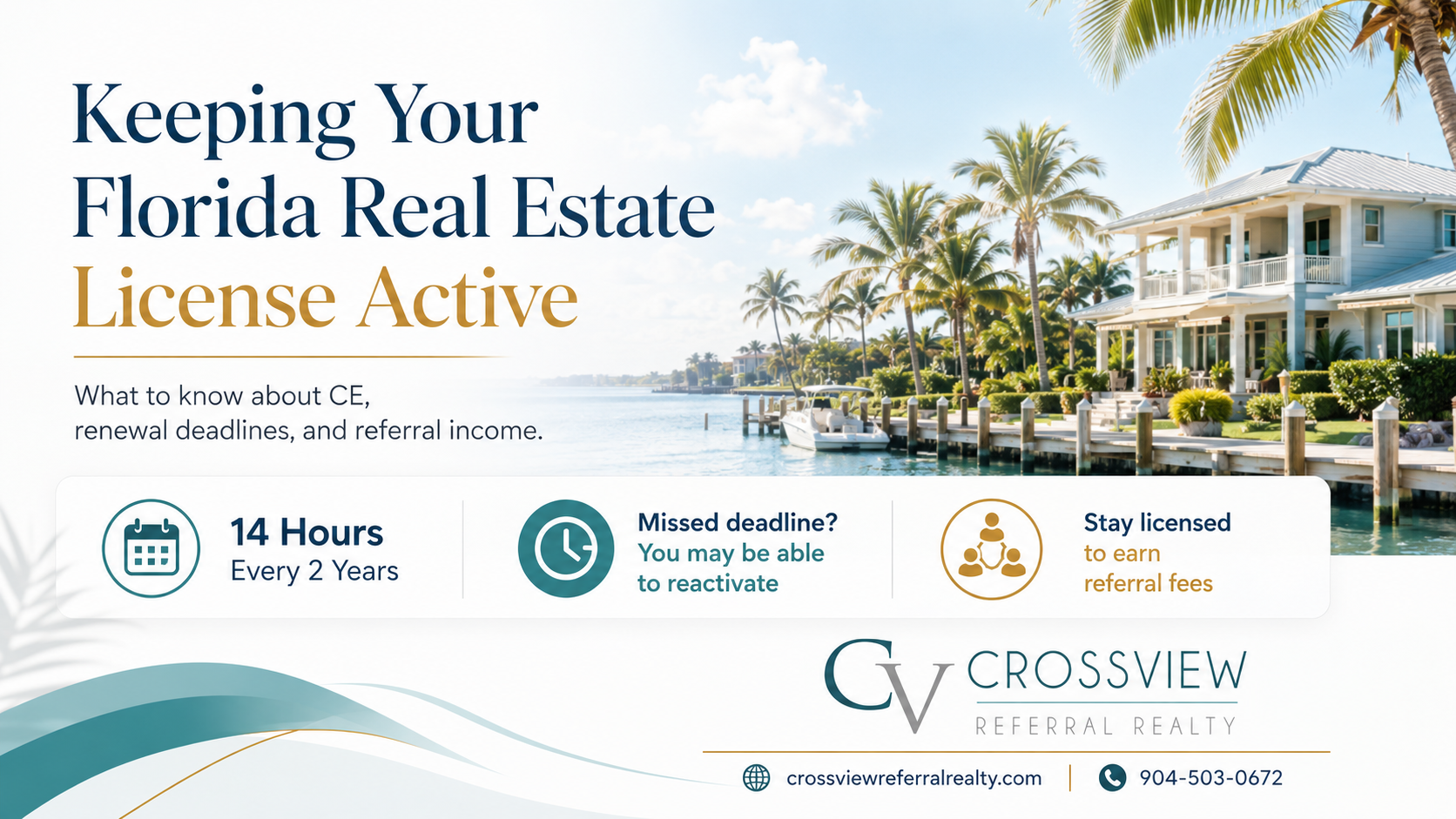
After your first renewal, Florida requires 14 hours of continuing education every two years — three hours of core law, three hours of ethics and business practices, and eight hours of specialty credit. Miss the deadline, and your license doesn't disappear outright; it moves to involuntary inactive status first.
What Florida's 14-Hour CE Requirement Actually Covers
Your first renewal cycle looks different from every one after it. Before that first deadline hits, you'll need to complete a 45-hour post-license course that builds on what you learned in pre-licensing. After that, it's 14 hours every two-year cycle: three hours of core law, three hours of ethics and business practices, and eight hours of specialty education you can generally choose based on your interests.
Florida real estate licenses expire on either March 31 or September 30, depending on when yours was originally issued, and that date repeats every two years. Your CE provider reports completed hours straight to the DBPR, so there's no separate paperwork to file on your end — you just need to finish before the deadline.
One exception worth knowing: if you're a Florida Bar member in good standing, you're exempt from the 14-hour CE requirement altogether.
What Happens If You Let Your Florida Real Estate License Renewal Slip
Missing your renewal date doesn't zero out your license the next morning. Here's how the timeline actually plays out.
If your license goes involuntary inactive for 1 to 12 months, you can get back to active status by completing the standard 14-hour CE course and paying a late fee. That's it — no exam, no extra coursework beyond what you'd have done anyway.
If it's been inactive for 13 to 24 months, the requirement steps up: you'll need a 28-hour reactivation course, plus the late renewal fee, before you're active again.
Past 24 months, the license becomes null and void. At that point you're not reactivating anything — you'd be starting over with pre-licensing education and the state exam, the same as a brand-new applicant.
That two-year window is the real deadline that matters if your license has gone inactive. As long as you're inside it, getting back to active status is a matter of coursework and a fee, not a fresh start.
Why So Many Referral-Only Agents Keep Their License Active Anyway
If you're not listing, showing, or negotiating contracts anymore, 14 hours every two years can feel like a strange thing to keep paying for. But for agents who've stepped back from production, an active Florida real estate license is really a key that unlocks one thing: the ability to legally earn a referral fee.
You don't need to be practicing to make that math work. You need a past client list, a network of people who ask you real estate questions at parties, and a brokerage built to receive and pay out referral fees without taking a cut for itself. The CE requirement becomes a small, predictable cost against income that can come in without you ever touching a listing again.
How CrossView Referral Realty Supports Referral Agents
CrossView Referral Realty is built specifically for Florida-licensed agents who want to stay active without going back into production. We don't take a cut of your referral fee, you choose which agent receives every referral, and it doesn't matter where in the country you live — as long as your Florida real estate license is current, you're eligible. There's no quota, no desk fee, and no pressure to do anything beyond what you're already comfortable with.
Keeping your license active is a manageable, known cost. What you do with it after that is up to you — and referral income is one of the simplest ways to make that 14-hour requirement pay for itself many times over.
If you're weighing whether to renew or let your Florida real estate license lapse, talk to us first. Visit crossviewreferralrealty.com or call 904-503-0672 to see how the referral model fits into what you're doing now.
Frequently Asked Questions
Q: How many CE hours do I need to renew my Florida real estate license? A: After your first renewal, it's 14 hours every two-year cycle — three hours of core law, three hours of ethics and business practices, and eight hours of specialty credit. Your first renewal instead requires a 45-hour post-license course.
Q: What happens if I miss my Florida real estate license renewal deadline? A: Your license moves to involuntary inactive status, not automatic cancellation. Within 12 months, a standard 14-hour CE course and a late fee reactivate it. Between 13 and 24 months, you'll need a 28-hour reactivation course instead. Past 24 months, the license becomes null and void and you'd have to start over.
Q: Can I keep my Florida real estate license active if I'm not actively selling? A: Yes. There's no requirement that you be practicing or affiliated with a production-focused brokerage. Plenty of agents keep their license active specifically to earn referral income through a referral-only brokerage like CrossView.
Q: Is it worth keeping my Florida real estate license active just for referrals? A: For a lot of agents, yes — the ongoing cost is the CE requirement and a renewal fee, and a single well-placed referral can outweigh that many times over. It depends on your network and how often real estate conversations come your way.
Q: Does CrossView Referral Realty help me track my CE requirements? A: We don't provide CE courses ourselves, but the requirement is straightforward once you know the three categories and your renewal date. Our team can talk through timing if you're unsure where you stand.