How Real Estate Referral Income Is Taxed: What to Expect
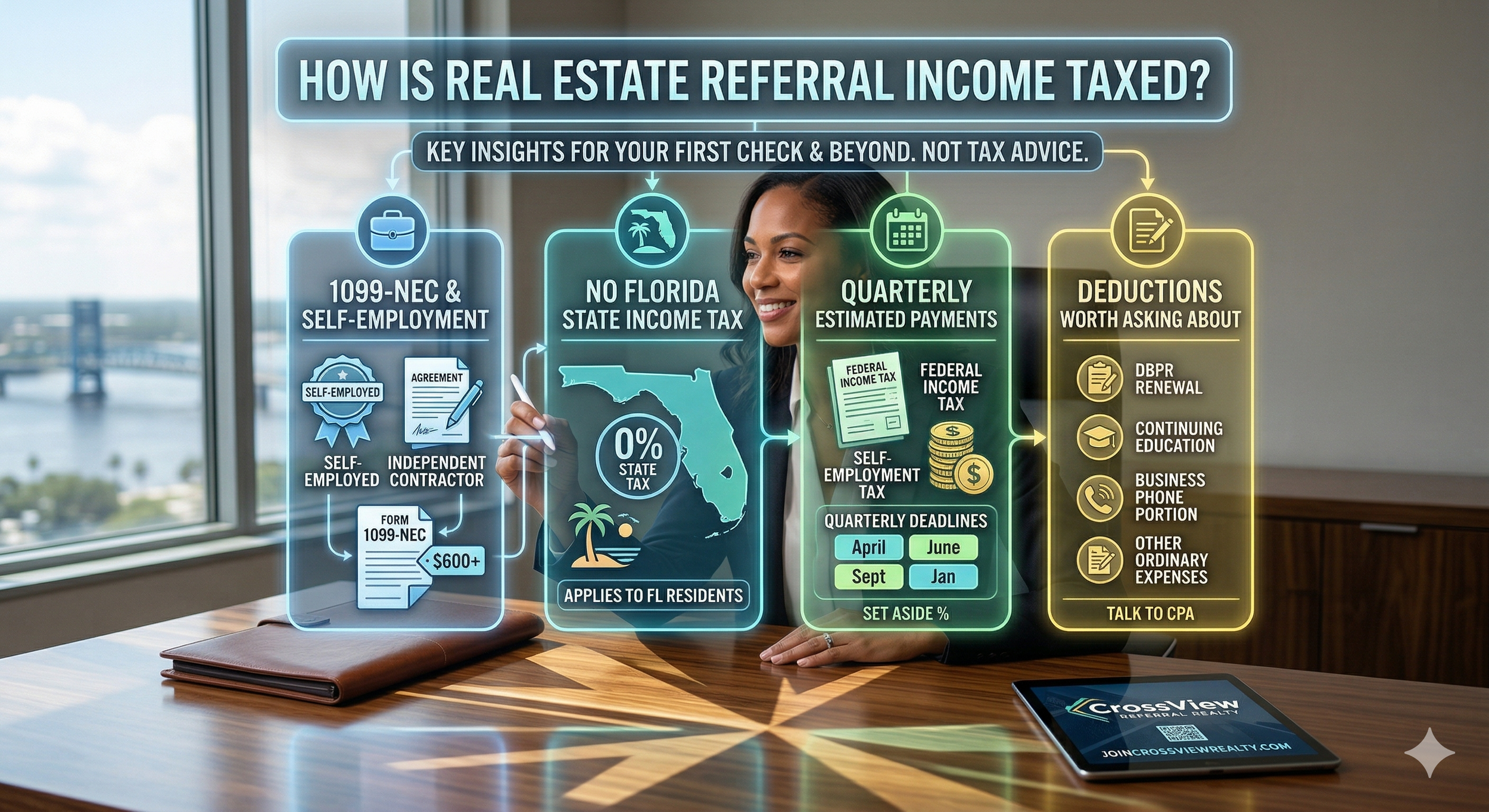
How is real estate referral income taxed — and what do you need to know before your first check arrives?
This is one of the most common questions agents have when they move to a referral brokerage, and it's a fair one. The short answer is that referral income is treated as self-employment income — which means a few things work differently than they would on a traditional paycheck. This post covers what to expect, what forms you'll see, and what questions to bring to a qualified CPA or tax professional. Nothing here is tax advice, and your specific situation will vary — but understanding the basics puts you in a much better position when tax season comes around.
Referral Income Is Self-Employment Income
When you earn a referral fee as a licensed real estate agent, you're operating as an independent contractor — not an employee. That's true whether you were actively selling homes before or whether you've been on the referral side from the start. The IRS treats licensed real estate agents as statutory nonemployees, which means your income is classified as self-employment income for federal tax purposes.
What that means practically: nobody is withholding taxes from your referral checks before they reach you. The gross amount comes in, and the responsibility for setting money aside and paying taxes falls entirely on you.
You'll Receive a 1099-NEC
At the end of each tax year, your brokerage will issue you a Form 1099-NEC reporting the total referral income paid to you during that year — as long as the total was $600 or more. This is the self-employment equivalent of a W-2. It doesn't mean taxes have been paid on that income. It means the income has been reported to the IRS, and you're responsible for what's owed.
Keep your 1099 when it arrives and make sure your mailing address on file with CrossView Referral Realty — and your W-9 — are current. Tax documents go to whatever address you have on record.
Florida Has No State Income Tax
One genuine advantage of holding a Florida real estate license and operating as a Florida referral agent: Florida has no state income tax. That means your referral income is subject to federal taxes only — not an additional layer of state income tax on top. For agents who live in Florida, this is a meaningful benefit worth understanding.
If you live in another state and hold a Florida license with CrossView Referral Realty, your home state's income tax rules will apply to your earnings. This is a conversation worth having with a tax professional who understands your state's specific requirements.
What You'll Owe Federally
Two types of federal tax apply to self-employment income. The first is federal income tax, which is calculated based on your total taxable income for the year and your filing status. The second is self-employment tax, which covers Social Security and Medicare contributions. As a self-employed person, you're responsible for both the employer and employee portions of these contributions — something traditional employees never have to think about because their employer covers half.
Your CPA can help you calculate what you'll owe based on your total income picture. This matters especially if referral income is supplementing other income sources — a pension, Social Security, investment income, or earnings from another job. All of it factors into your overall tax situation.
Quarterly Estimated Payments
Because no taxes are withheld from your referral checks, the IRS generally expects self-employed individuals to make quarterly estimated tax payments throughout the year if they expect to owe $1,000 or more in taxes. The quarterly deadlines fall in April, June, September, and January. Missing these payments can result in penalties at filing time — even if you pay the full amount owed by April 15th.
Setting aside a percentage of each referral payment as it arrives — rather than waiting until the end of the year — is a simple habit that prevents a painful surprise come tax season. Your CPA can help you determine what percentage makes sense for your situation.
Deductions Worth Asking Your CPA About
As a self-employed referral agent, you may be able to deduct certain business expenses against your referral income — potentially reducing your taxable income. Common deductions for referral agents worth discussing with your CPA include your DBPR license renewal fee, continuing education course costs, the portion of your phone used for business, and any other ordinary and necessary expenses directly related to operating as a referral agent.
What qualifies, and how to document it properly, is a conversation for a qualified tax professional. The rules around deductibility are specific, and getting them right matters.
Talk to a CPA Who Understands Self-Employment Income
If you've spent years as a W-2 employee or haven't had self-employment income before, the referral model introduces a few new moving parts at tax time. They're manageable — but they're worth understanding before your first closing, not after.
At CrossView Referral Realty, we want our agents set up for success in every part of the referral model — including the financial side. If you have questions about how we report income or what documents we provide, we're happy to help. Visit crossviewreferralrealty.com or call us at 904-503-0672.
FAQ
Q: Will I get a W-2 or a 1099 from CrossView Referral Realty? A: You'll receive a 1099-NEC — not a W-2. As a referral agent, you're an independent contractor, not an employee. Your brokerage will issue a 1099-NEC at the end of the year reporting the total referral income paid to you, provided it totals $600 or more. No taxes are withheld before the payment reaches you.
Q: Do I have to pay taxes on referral income if I only earned a small amount? A: Yes — all self-employment income is reportable and potentially taxable, regardless of the amount. Even if you don't receive a 1099-NEC because your earnings were under $600, the income is still technically required to be reported on your federal return. Talk to your CPA about how to handle smaller amounts correctly.
Q: Does referral income affect my Social Security benefits? A: This depends on your age, how much you earn, and whether you're already receiving Social Security benefits. Earned income — including self-employment income — can affect your benefits if you're below full retirement age. This is an important question to bring to both your CPA and your financial advisor before you start earning referral income regularly.
Q: What records should I keep for tax purposes as a referral agent? A: Keep records of every referral payment you receive, copies of your 1099-NEC forms, any business expenses you plan to deduct, and documentation showing how those expenses relate to your referral activity. Keeping a simple spreadsheet throughout the year is far easier than reconstructing everything in April.
Q: Can I set up an LLC to receive my referral income? A: Some agents choose to structure their referral activity through a legal entity like an LLC. Whether that makes sense for your situation depends on your overall income, tax goals, and the rules in your state of residence. This is a decision to make with the guidance of a CPA or attorney who understands both Florida real estate licensing requirements and your personal tax situation.