Social Media for Real Estate Referral Agents: What to Post
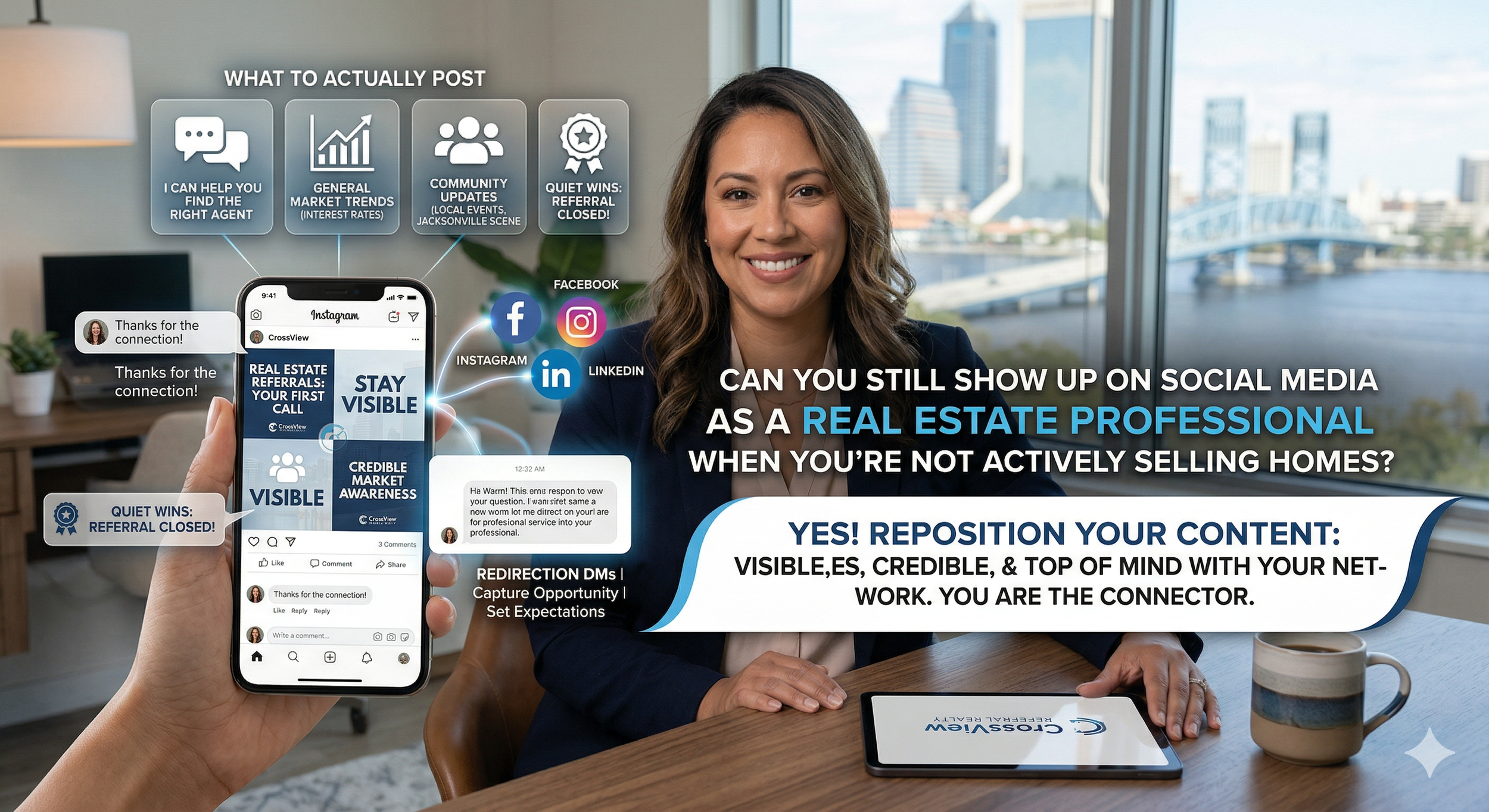
Can you still show up on social media as a real estate professional when you're not actively selling homes?
Not only can you — you should. Social media is one of the most effective tools a referral agent has for staying top of mind with their network. But the way you use it looks different from how an active agent uses it. And getting that positioning right makes all the difference between a feed that generates referrals and one that creates confusion.
Here's how to do it well.
Before posting: Real-estate advertising by a CrossView Referral Realty Associate must comply with Florida advertising requirements and CrossView's advertising policy. Your marketing must appropriately identify your brokerage affiliation and cannot imply that you provide traditional buyer, seller, listing, or property-management services.
Your Goal Is Different — So Your Content Should Be Too
Active agents use social media to promote listings, attract buyers, and generate leads. That's not your job anymore. Your job is to stay visible, stay credible, and make sure the people in your network think of you first when real estate comes up — so they reach out and you can connect them with the right agent.
That means you're not posting open house announcements or listing photos. You're showing up as the person in your network who is still deeply connected to real estate, still paying attention to what's happening in the market, and still available to help — just in a different way than before.
The positioning is simple: you're not selling homes. You're connecting people with the agents who are.
What to Actually Post
You don't need to post every day. Consistency matters more than volume. A few times a week — or even a few times a month if that's what's sustainable — is enough to stay on people's radar. Here's what works for referral agents:
"I can help you find the right agent" posts. Straightforward and effective. Something like: "I'm no longer working directly with buyers and sellers, but I'm still very connected to the market and to some great agents across Florida and the country. If real estate is on your mind, reach out — I'll point you in the right direction." Do this periodically, especially after you first make the transition.
General market awareness content. You don't need to be in the trenches to share what's happening in the market. A quick post about interest rate trends, what's happening with Florida inventory, or the fact that certain markets are moving faster than others positions you as someone still paying attention. You don't need to be an expert — just informed.
Personal check-ins and community content. Real estate is a relationship business. Posts about local events, things you love about your area, or personal milestones keep you present in people's lives in a way that feels natural rather than promotional. People do business with people they feel connected to.
Quiet wins. When a referral closes and your client is happy, you can share that — without naming names or violating anyone's privacy. Something like: "Had a great moment this week — someone I connected with an amazing agent just closed on their new home. Love being able to help even in a different way." That's both authentic and effective.
Which Platforms Matter Most
For most referral agents, Facebook is the highest-value platform. That's where your sphere of influence — past clients, neighbors, family, longtime connections — is most active. A post on Facebook reaches the people who already know and trust you, which is exactly your audience.
Instagram is worth maintaining if you were already active there, but it doesn't need to be a major focus unless you enjoy it. It's better for reach with people who don't know you yet, which is less relevant for the referral model.
LinkedIn is underused by most agents and surprisingly effective for referral agents. If you have a professional network — former colleagues, business contacts, community connections — LinkedIn is where those people are. A post on LinkedIn about your transition to referral-only can reach an entirely different audience than your Facebook friends.
Pick the platforms you'll actually use consistently. One platform done well beats three platforms done poorly.
How to Handle DMs Asking You to Show Homes
This will happen. Someone sees that you're in real estate, messages you, and asks if you can show them a house or help them list.
Don't ignore it — that's a referral opportunity. Respond warmly and redirect clearly:
"Thanks so much for reaching out! I'm actually on the referral side of real estate now, which means I don't work directly with buyers and sellers anymore — but that's exactly why you should still come to me. I'll connect you with the right agent for your situation and make sure you're in great hands. What are you thinking about doing?"
That response keeps the door open, captures the lead, and positions you as helpful rather than unavailable. It also sets the expectation clearly so there's no confusion about your role going forward.
Consistency Is the Only Strategy That Works
The agents who generate the most referral income from social media aren't the ones with the most followers or the most polished content. They're the ones who show up regularly enough that when someone in their network thinks "I need to talk to someone about real estate," their name comes to mind.
You don't have to perform. You don't have to have a ring light or a content calendar. You just have to stay present — and let people know you're still connected, still available, and still a resource worth calling.
At CrossView Referral Realty, we work with agents who are building exactly this kind of referral business — low pressure, flexible, and built on relationships. If that sounds like the right fit, visit crossviewreferralrealty.com or call us at 904-503-0672.
FAQ
Q: Do I need to be on social media to be a successful referral agent? A: No — plenty of referral agents generate income purely through personal relationships and direct outreach without any social media presence. But if you're already active on social, staying visible there is one of the easiest ways to keep your network aware that you can still help them. The key is consistency, not volume.
Q: What should I say in my social media bio now that I'm a referral agent? A: Keep it simple and clear. Something like: "Florida-licensed real estate agent | Connecting buyers and sellers with the right agents across Florida and the U.S. | Ask me how I can help." You want people to immediately understand what you do and how to reach you — without a lengthy explanation of what a referral brokerage is.
Q: How do I respond when someone comments on my post asking me to help them buy or sell? A: Respond publicly with warmth and redirect the conversation to a private message. Something like: "Absolutely — send me a message and let's talk! I'll connect you with the right agent for your situation." Then handle the referral privately. A public comment showing that you're responsive and helpful is actually good for your visibility.
Q: How often should a referral agent post on social media? A: Often enough to stay present, infrequently enough that you'll actually keep doing it. For most referral agents, two to four posts per month is realistic and effective. The goal isn't to dominate anyone's feed — it's simply to remind your network periodically that you're still the person to call when real estate comes up.
Q: Can I share listings from other agents on my social media? A: You can share publicly available listing content for informational purposes — to comment on market trends, highlight what's active in a certain area, or illustrate a point about the market. What you shouldn't do is promote a listing in a way that implies you're the listing agent or that you're representing either party in the transaction. When in doubt, keep the focus on general market commentary rather than specific properties.