Florida Real Estate License First Renewal Requirements: Don’t Miss the 45-Hour Rule
Is your first Florida real estate license renewal coming up?
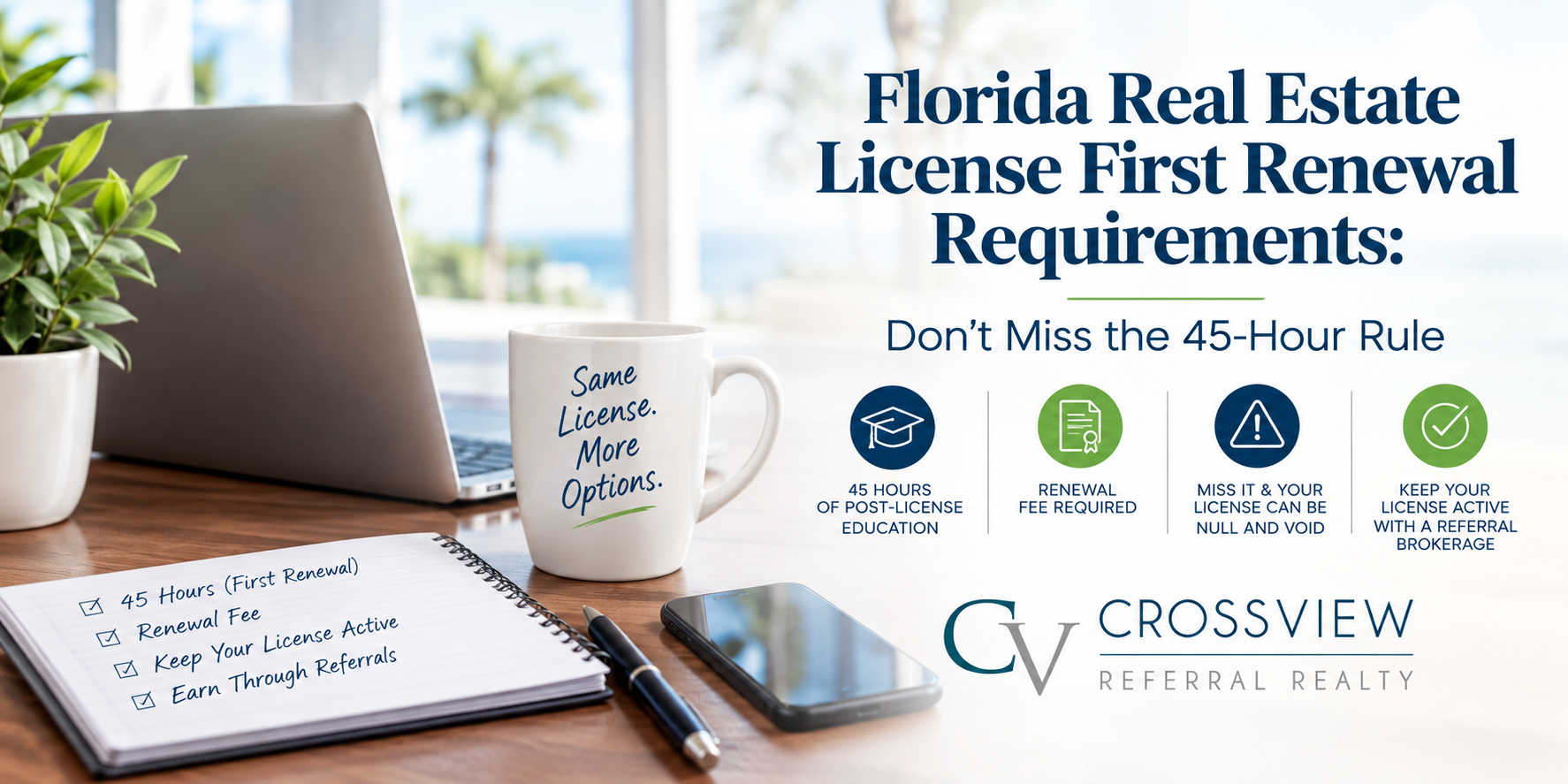
For a Florida sales associate, the first renewal requires completing 45 hours of approved post-license education before the license expiration date, along with the required renewal fee. This deadline matters because failing to complete the post-license requirement can cause the license to become null and void — not simply inactive.
That’s a much bigger consequence than many new agents realize.
Why Your First Florida Real Estate License Renewal Is Different
Once you’ve had your license for a while, you’ll probably hear agents talk about “doing their CE.”
But your first renewal is different.
Florida sales associates renewing for the first time complete 45 hours of post-license education. This is not the same as the standard 14-hour continuing education requirement that applies to later renewal cycles.
So if you recently earned your license, don’t assume you can take a regular 14-hour CE course and call it done.
For your first renewal, the 45-hour post-license requirement is the one that matters.
Florida DBPR also requires the applicable renewal fee by the expiration deadline. Your specific expiration date can be confirmed through your DBPR license record, and Florida real estate licenses generally renew on either March 31 or September 30.
If you want a broader look at what happens after that first renewal, our guide to Florida real estate license renewal and continuing education explains the ongoing CE cycle.
What Happens If You Miss the 45-Hour Post-License Requirement?
This is the part worth paying attention to.
For a Florida sales associate, failing to complete the required post-license education before the first renewal deadline can make the license null and void.
That is different from simply missing a later renewal and temporarily falling into involuntary inactive status.
If a sales associate’s license becomes null and void because the first-renewal post-license requirement was not completed, Florida law requires the person to requalify to become licensed again. That means completing the required sales associate pre-license course and passing the state licensing exam again.
In other words, this is not a deadline you want to casually push past.
First Renewal vs. Later Renewals
| Requirement | First Renewal — Sales Associate | Later Renewal Cycles |
|---|---|---|
| Education | 45-hour post-license course | 14 hours of continuing education |
| Renewal fee | Required | Required |
| Must finish by expiration date | Yes | Yes |
| Missing education can immediately make license null and void | Yes, for the required post-license education | Different inactive/reactivation rules generally apply |
| Referral-only agents exempt | No | No |
Moving your license to a referral-only brokerage does not change these Florida licensing requirements.
At CrossView Referral Realty, we remove the need for board and MLS dues through our referral-only model, but we do not remove DBPR renewal fees, post-license education, or continuing education requirements.
That distinction is important.
Going Referral-Only Does Not Eliminate Your Licensing Requirements
Maybe you earned your Florida real estate license and quickly realized that active sales isn’t what you want to do long-term.
Or maybe life changed.
You started another career. You moved. Your schedule got busier. You still want to keep the license you worked for, but you don’t want to build a traditional real estate business.
That’s where a referral-only brokerage can be useful.
With CrossView Referral Realty, you can keep your Florida real estate license active without paying board or MLS dues and without taking listings, showing homes, working buyers, or meeting production quotas.
But there’s an important tradeoff to understand: your state licensing obligations still apply.
You still need to:
- Keep your Florida real estate license current and active.
- Complete the education required for your particular renewal cycle.
- Renew with DBPR by the applicable deadline.
- Pay required state renewal fees.
And if you want to legally earn a real estate referral fee, your license must remain active.
If you’re approaching your first renewal and already know traditional production isn’t for you, you can learn how becoming a Florida referral agent works while making sure you complete that 45-hour requirement on time.
How CrossView Referral Realty Works for You
CrossView Referral Realty is designed for Florida-licensed agents who want to step away from transactions without giving up the ability to earn from referrals.
There are no board or MLS dues, no required production, and no expectation that you take listings or work directly with buyers. When you have someone who needs a real estate agent, you can make a referral instead of handling the transaction yourself.
If an eligible referral closes and a referral fee is earned, CrossView referral agents can receive up to 90% of that referral fee. Payment is typically made by direct deposit within 2–4 business days after CrossView receives the referral fee.
Referral-only makes the business side simpler. It doesn’t make the licensing side disappear.
What Should You Do Before Your First Renewal Deadline?
First, confirm the expiration date on your Florida license.
Don’t rely on when you think you got licensed or when another agent says your renewal should be due. Check your actual DBPR record.
Then confirm that the course you’re taking satisfies the 45-hour sales associate post-license requirement. A standard 14-hour CE course is not a substitute for your first-renewal post-license education.
And don’t save everything for the last day.
Your first Florida real estate license renewal has more riding on it than a routine renewal later in your career. Finishing early gives you time to address a course, reporting, payment, or account issue before the deadline becomes a problem.
For another explanation of the difference between post-licensing and CE, see Is Continuing Education Required to Keep My Real Estate License?.
Keep the License — Even If You Don’t Want the Sales Business
You may decide that listings, showings, contracts, and weekend appointments aren’t for you.
That doesn’t mean earning your Florida real estate license was a waste.
The key is keeping it active correctly.
Your Florida real estate license first renewal requirements deserve extra attention because missing the 45-hour post-license deadline can have a much bigger consequence than missing an ordinary CE deadline later.
Complete the requirement, renew on time, and then decide how you actually want to use your license.
If referral-only fits better than traditional production, join CrossView Referral Realty and keep your license working through referrals without the board dues, MLS dues, or day-to-day transaction work.
Frequently Asked Questions
Q: How many hours do I need for my first Florida real estate license renewal?
A: A Florida real estate sales associate must complete 45 hours of approved post-license education before the first renewal following initial licensure. You also need to satisfy the applicable DBPR renewal requirements and fee. The 14-hour continuing education requirement generally applies to later renewal cycles, not this first one.
Q: What happens if I don’t complete the 45-hour Florida post-license course before my deadline?
A: Florida law provides that a sales associate who fails to complete the required post-license education before the first renewal has a license that becomes null and void. To operate again as a sales associate, the person generally must requalify by completing the required pre-license education and passing the state examination again. Because individual circumstances can vary, confirm your status directly with DBPR if you are at or past your deadline.
Q: Is the 45-hour post-license course the same as Florida’s 14-hour CE course?
A: No. The 45-hour course is the post-license education requirement for a sales associate’s first renewal. After that first renewal, Florida’s standard continuing education requirement generally applies to subsequent renewal cycles. Taking a 14-hour CE course does not replace the required 45-hour post-license course for a first-time sales associate renewal.
Q: Do I still have to complete my first-renewal education if I join a referral-only brokerage?
A: Yes. Referral-only status does not exempt you from Florida licensing requirements. CrossView Referral Realty eliminates board and MLS dues through its referral-only model, but you are still responsible for your DBPR renewal, required education, and state renewal fees. Your Florida license must remain active for you to legally earn referral compensation.
Q: Do Florida brokers also take the 45-hour post-license course?
A: No. Florida has a separate first-renewal post-license requirement for brokers, which is different from the sales associate requirement discussed in this article. Brokers should verify their current post-license education requirement and deadline directly with DBPR. This article is focused on Florida real estate sales associates approaching their first renewal.
About CrossView Referral Realty
CrossView Referral Realty is a Florida referral-only real estate brokerage that helps licensed agents earn income without actively selling. Agents keep their Florida license active, avoid board and MLS dues, and earn up to 90% commission by referring buyers and sellers to trusted agents anywhere in the country.
CrossView Referral Realty · (904) 503-0672 · info@crossviewreferralrealty.com. Referral fees may only be paid to licensed real estate agents or brokers. An active Florida real estate license is required to legally earn a referral fee; joining CrossView Referral Realty removes board and MLS dues but does not remove DBPR license renewal fees or continuing education requirements. This article is general information only and does not constitute legal, tax, or financial advice. It is not a guarantee of income or referral volume — individual results vary. Confirm your specific license status and requirements with the DBPR.